
Discipline for Little,
Middle and Big Kids
Parents and teachers are concerned about appropriately disciplining their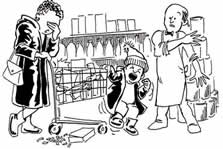 kids from the time they are little toddlers up through middle childhood and the teenage years. The goals of discipline are for children to learn skills and values that will prepare them for adulthood, when they will depend entirely on themselves for self-discipline and, hopefully, will result in their leading happy, fulfilling, and caring lives. There should always be a positive emphasis in discipline. Your pleasure in your children's accomplishments and your disappointment in their inappropriate behaviors are your most effective tools for discipline. Realistic parents also find that there are times when raising your voice or setting firm limits are required for helping children grow in confidence.
When and how to discipline varies considerably according to your children’s developmental stages and individual personalities. Although your family values will shape the direction of your children's growth, at birth, genetic make-up provides infants with a variety of temperaments as well as considerable differences in energy and capabilities. Of course, school and peer environments will also affect your children's discipline requirements. There are, however, some discipline generalizations that seem to fit all ages and personalities. A first priority is to teach your children positively, so they feel loved; a second is to set limits when your children have temporarily gone astray.
Research tells us that for children of all ages, physical punishment causes many problems. It becomes a model for aggression in an already too violent society. It causes children to be angry with their parents and sometimes with the rest of their world. If you're feeling a little guilty because you've already spanked your children a time or two, let me assure you that an occasional slip is unlikely to do harm and that you're surely not alone with either your deliberate spanking or accidental loss of control.
There continue to be parents who believe the old maxim of "spare the rod and spoil the child." There may have been a time when physical punishment or the threat thereof was sufficient to keep a child in line. However, in the present world of empowered children and continued exposure to media violence, the first spanking often only leads to another, and another. That may be followed by physical abuse and may even pit parents and children against each other in physical fights. It's much better and safer to use other punishments. Hopefully, you’ll also have sufficient control of your children so that either your voiced disappointment, consequences, or time-outs will suffice to deter further inappropriate behaviors.
LITTLE KIDS (PRESCHOOLERS)
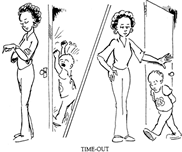 As soon as babies begin to crawl or toddle, you'll begin your disciplining. Making spaces safe for kids by rearranging, locking, or protecting is much more effective than slapping their hands and saying "no" every few minutes. Of course, no environment can be completely childproofed.
Saying "no" or using a descriptive word such as "hot" in a slightly raised and serious voice, paired with a distraction to some other toy or activity, works well until children approach two years of age. Biting or hitting can be curbed with "no" followed by "nice" while giving a patting or hugging lesson. When that isn't effective, a brief time-out in a crib or room will usually work. A gate that separates children from a parent's attention seems to stop the problem after a time or two. For children who climb over gates, installing two gates vertically has been effective.
You may worry that somehow children will learn to dislike and fear their bedrooms. Thousands of families have used this simple time-out technique, and only one parent has ever reported to me of a child becoming afraid of a crib. Sometimes children fall asleep or play with toys instead of just crying. Time-out is not a punishment, only a temporary withdrawal of attention, and is much more effective than continuous scolding or spanking, which are the usual alternatives.
Parents who structure the day with time for free play inside and outside, interaction with other children, and some adult-child nurturance by reading, talking, and playing together establish order and expectation. Of course, flexibility during that time is important for little children, and little kids definitely need plenty of hugging and affection (only, please don’t do the hugging right after a punishment, or kids are thoroughly confused).
MIDDLE KIDS (SCHOOL AGE)
Structuring children's lives positively so that fun activities follow more arduous or tiresome chores works best with school-age children. For example, statements such as, "After I look over your homework, we can shoot baskets or play checkers" work better than saying, "If you don't get your homework done, we're not playing any games tonight." The difference only appears to be a matter of words, but actually how you say it is also important. The first statement keeps you in an alliance with your children, instead of embattled as does the second statement.
Reasonable consequences are effective with children. "Family dinner is on. Right after your puppy is fed, please join us" makes sense to a child who has not yet fed the dog. A few minutes later, the child will join you at the table and won’t require any special attention for the brief delay.
Time-out in their rooms continues to be appropriate for school-age children who may lose their tempers or be inappropriately aggressive. Assuming you've given them a reason why their behavior is wrong, don’t try reasoning with them while both you and they are losing tempers.
Discussion works well with children unless it becomes a debate in which your reasoning is only an excuse for their plans to win. In my book How to Parent So Children Will Learn (Crown, 1996), I discuss a very effective anti-arguing routine. This routine works for little, middle, and big kids and can help convert a warring camp into a happy household.
BIG KIDS (TEENAGERS)
Teenagers are stretching toward adulthood and need to feel that adults aren’t talking down to them. At the same time, they need to know that parents are firmly guiding them even as they protest about too much adult control. Forming an alliance with them, hearing them out, and allowing plenty of talk time for them are much more difficult during these most challenging and interesting years. They watch parents more carefully than ever. If you model a happy, disciplined lifestyle, it serves as an important guide.
Try to avoid battles in which you can't control the outcomes, but stay firm on your most important issues. Timing-out your teenagers probably won’t work, but you may instead avoid being sucked into battle by assertively timing yourself out in your own room (with locked door) when you've already concluded your discussion, and they haven't. Don't tell them or let them know you're desperate. Simply explain you have other activities to attend to that require the quiet and concentration of your room.
Most important, if there is more than one parent or adult involved, stay united. Otherwise, teenagers who don't like to accept “no” will find another adult to side with them against you, and that will only force you to feel like an ogre. While indeed you may sense that they=re manipulating the adults who love them, for them it only feels as though one adult understands them and another adult doesn't. Parents should stay united, be positive (if possible), and set reasonable limits together. Compromise between parents is much more effective than one adult becoming the mediator and leading the teenager to find an easy way out of responsibility.
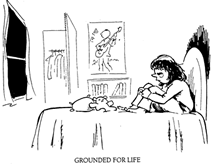
Consequences for teenagers' inappropriate behaviors can be loss of car privileges, allowances, or brief (one time or weekend) groundings. Grounding for weeks or months is not likely to be within your control and is completely ineffective. Teenagers dig in their heels in anger, and your chances for a positive alliance disappear. Try to remember when you were a teenager to help guide you through an increasingly difficult adolescence. Underneath the negative and angry facade of an adolescent is a nice kid who needs and loves you.
“BAD” AND DISRESPECTFUL LANGUAGE
It used to be considered developmentally normal for teens to talk back to their parents for the first time when they hit adolescence. Typically when families established that disrespectful or foul language was inappropriate, teens would clean up their language at home, although they would often experiment with cursing or “bad words” around their friends. Most parents today would probably agree that those were the good old days.
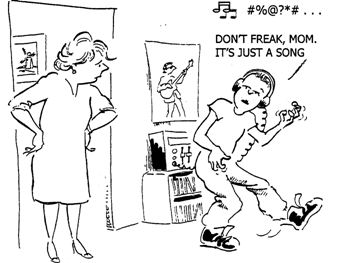 The bad language used by teens now often begins by the preschool years and expands exponentially so that home, school, and Internet conversation between teens and even tweens is so riddled with disrespectful, violent, and angry language that parents can hardly punish or frighten it away. Like MTV, you wish the kids could use a bleep to cover the F, B, and S words. Some may think it’s too late to intervene, so they might as well ignore the language despite their disapproval. For many others, early interventions can prevent the spread of disgusting and disrespectful talk. Here’s some advice for those who haven’t already let the vulgarity get out of hand:
- Proactively teach children how to express their feelings. Even anger can be explained in words. For preschoolers, that may mean teaching them specific words. For adolescents, it would involve providing them time for your listening and a sense of safety and acceptance.
- Sensitize children to understanding the meanings of the words they use. For very young children, you’ll want to call them “good words” and “bad words.” Some parents refer to bad as “potty” words. For older children, understanding the meaning of what they’re saying will help prevent using vulgar language.
- Help children to understand that violent language will be taken seriously and punished at home and school. Some schools are on the alert for vulgar words and may even be expected to overreact in an environment in which there has already been so much violence. Parents need to encourage their children to stop themselves, and think before they talk. Unfortunately, in some schools, vulgar language is accepted because educators are overworked with other priorities.
- If disrespect begins, both parents should use the same consequences immediately. For example, time-out, no TV for the night, or charging a fine. Also, you should be very clear that disrespectful language will never be accepted in your home. You can’t control the language outside your home when your children are with peers, but at least you can maintain a reasonably wholesome atmosphere within. You can assume that there’s no real danger in normal experimentation with bad language, and it’s simply part of growing up.
- Correct your children’s friends if they use inappropriate language when visiting. You could say, “We don’t use those bad words in our house. Here’s how we would say it.” Then give them a better example. If kids’ influence is too bad, you may want to steer your children to other friends until they clean up their act.
- Monitor the adult language used around children. Children repeat or exceed your worst language in their efforts to seem grown up. If you slip once in awhile, you’re human. If your kids slip occasionally, remember they’re also human.

Here are some questions asked by parents that may help you answer your own questions.
Dear Dr. Sylvia,
Our three-year-old son has begun to use foul language. It’s becoming more frequent. We’ve been ignoring him; however, his six-year-old sister now screams out, “MOMMY, Bobby said F--- again!” We don’t know who to reprimand and who to put in time-out. Any suggestions??
Dear Parents of Boy with Foul Mouth,
Decisions like this are always harder when several children are involved. For starters, it’s a good idea to determine where your son is learning the language. Is it possible that Big Sister is the one who’s teaching him the words? She seems awfully anxious to get him into trouble, but I guess that’s not untypical for an older sister.
Although ignoring the language might have worked if he were alone, it surely is not working now. Try this approach: explain to your son that he’s using bad words and he will have to go to his room for a few minutes. Then follow through immediately. Only a few minutes and a few times should take care of the problem.
Remind his sister that you can manage this discipline on your own, and if she reports on her brother, you will follow through and time him out. However, if she uses the bad words when she reports him, both children will go to their rooms. It may help for you to know that sometimes ignoring doesn’t work even with one child, but time-out is usually very effective if you use it consistently.
Dear Dr. Sylvia,
Should I ignore comments/swearing from my adolescent after I have set limits?
Dear Parent of Disrespectful Teen,
You can ignore comments, but I suggest you establish a penalty for swearing. A dollar for each time a child swears usually reduces the habit. Tell your adolescent of the plan in advance and keep track in an obvious way. Explain that you believe she can express herself better, and you’d like to help her break the habit. She’ll get the idea when her allowance disappears.
Also, suggest that if she feels so angry, she can go to her room and write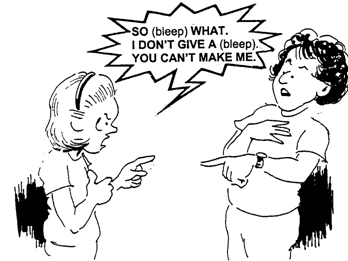 down all the swear words she likes without being penalized. Perhaps that will help her to get them out of her system without causing you to feel so disrespected. You can also set up a reward system by offering to get her something special if she can go swear-free for a few months.
Yes, it’s just a stage, but parents shouldn’t have to accept such an ugly habit. If your teen swears among her friends out of your hearing, no intervention is required. What you don’t hear doesn’t hurt, but don’t hesitate to let her know you believe she can be more refined and smart.
Dear Dr. Sylvia,
A good friend of mine has a son who plays with my two children often. This boy has a difficult time expressing his true emotions and often expresses himself by doing the opposite of how he is feeling (e.g. when my children have to go home, he says, “I hate you, you are not my friends.”) This child often uses bad language and encourages this with my children. Although I feel it’s important for my children to learn to use their own brains and develop their own value systems, they are only three and five and easily influenced. The boy’s mother is a dear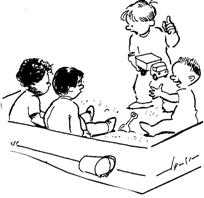 friend of mine, and the boys truly like one another, so I don’t want to eliminate their playdates completely. Are there things that I can do to teach my children how to behave the way they normally do when not with this child? And how do I explain to them that their friend does truly care for them when he is expressing the opposite sentiment? Any help would be beneficial. Thank you.
Dear Mom of Good Kids,
Your preschool children can’t be expected to understand that a child telling them he hates them really means he likes them. If it happened once or twice, you could explain it away as the boy being overtired or just making a joke. However, if your children are regularly exposed to a child who uses bad language and is mean to them, it will adversely affect them.
I suggest you tell your friend that her son is too hard on your kids and you’ve decided to suspend play dates for awhile. Perhaps this will give your friend the idea that her son has a problem. She may even get some help. If you’re clear and open with her, you may actually be helping her son as well as your own children. Although occasional misbehavior is normal, a steady stream of inappropriate behavior can have a very negative influence on your children during their very vulnerable preschool years. You can find them other friends.
©2010 by Sylvia B. Rimm. All rights reserved. This publication, or parts thereof, may not be reproduced in any form without written permission of the author.