
SOLVING THE MYSTEROIUS
 |
ACHIEVEMENT PROBLEM |
Parents continually take stock of their children’s school progress. Hopefully their children are making good efforts, earning positive grades, and enjoying school. For some parents, there comes a time when they realize that their children’s small problems are simply not disappearing. They wonder why their children are not working to their abilities in school. They may have already heard the word "underachiever" from an earlier teacher, but they hoped their children would mature out of the problem. The parents are puzzled, and so are the children’s teachers.
UNDERACHIEVEMENT IS EPIDEMIC AND ENTERS EVERY CLASSROOM AND MANY HOMES
Underachievement |
|
Some School Causes |
Some Home Causes |
|
|
Underachievement is epidemic and enters every classroom and many homes. Underachievers usually begin as apparently bright and often very verbal preschoolers, but at some point their enthusiasm for learning and their satisfactory school performance change. Symptoms of underachievement may include unfinished work, loss of homework, disorganization, disinterest in school, excuses like "I forgot," blaming others for problems, and declining grades.
Underachievement results when some things go wrong both at home and school. Underachievers deny themselves the opportunity to build confidence because they direct their energies toward avoiding the relationship between process and outcome, between effort and achievement.
DEPENDENCE AND DOMINANCE
Well-intentioned parenting mistakes frequently have the effect of destroying parenting leadership. The children learn rituals of either unusual dependence or dominance, or both. These dependent and dominant patterns begin to feel natural to children and parents alike. Parents often believe that teachers and the school structure will resolve their children’s problems or that children will mature out of them. Dependent and dominant children may have practiced their control patterns in relating to adults for several years before they enter school. These patterns seem to work well for them, and they know no others. They may carry them to the classroom from home or learn them in the classroom. They continue to use them to preserve their fragile self-concepts.
The dependency pattern is often masked as insecurity, immaturity, passivity, or learning disabilities. Dependent underachievers ask for more help than they require. They may insist on having parents sit with them while they do their homework. Dominant underachievers are more vociferous in arguing about why they shouldn’t have to do their work; they tend to blame teachers or parents for their problems. They like to pick and choose only the schoolwork they enjoy.
PREVENTING UNDERACHIEVEMENT
Parenting by positive expectations can be extraordinarily successful for children both in school and out. If high achievement, positive attitudes, and constructive behavior are expected and reinforced by parents, they will become internalized by the child. Parents should share with their children realistic and positive views of achievement.
Model hard work and satisfaction of accomplishment. Hard work is not enough. Hard-working parents who constantly complain about their jobs are not good role models. Children should hear their parents speak in a more balanced way about the satisfactions of achievement. Imitation of good role models is very important in the reversal of underachievement.
Voice your sincere respect for educational institutions and teachers. Children avoid work and learning if teachers are not respected by their parents. Set up a regular communication with the child’s teacher.
 Involve
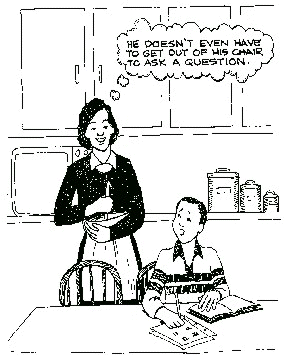
your children in developing study routines. Don’t sit with your children when they study,
but be interested and review work. Disorganization
is a frequent symptom of underachievement. Reasonable
structure and organization are necessary for accomplishment
and dealing with responsibilities.
Involve
your children in developing study routines. Don’t sit with your children when they study,
but be interested and review work. Disorganization
is a frequent symptom of underachievement. Reasonable
structure and organization are necessary for accomplishment
and dealing with responsibilities.
Be consistent with your children’s other parents(s) in setting goals for children. If one parent sets higher goals than the other parent, children are likely to choose the easy way out. Don’t ally with your children against the other parent, no matter how subtly.
Help your children cope with competition. Explain that being best is not as important as doing their best, and that winning and losing are temporary. Discuss effort, problem-solving strategies, creative-thinking processes, and ways of dealing with failure. "Magical" thinking, which emphasizes success by luck and without effort, causes problems for children. Children who give up easily and get by with a minimum of effort have little or no confidence in their abilities to function successfully. Children build confidence by achievement.
Encourage independence in your children without giving them more power than they can handle. Parents should be clearly in charge, although children should be able to make choices and voice opinions within limits. Encourage your children’s strengths and interests. Emphasize the positive, and plan fun family activities even if family time is limited. Limit screen time, including television, video/computer games, and the Internet.
 Praise
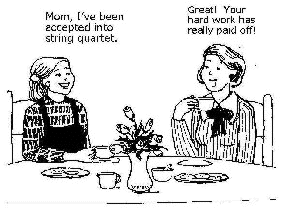
children realistically with words that set goals
they’ll be able to achieve. "Bright," "good thinker," "kind,"
and "persevering" are fairer than "brilliant,"
"genius," "smartest," or "perfect."
Praise
children realistically with words that set goals
they’ll be able to achieve. "Bright," "good thinker," "kind,"
and "persevering" are fairer than "brilliant,"
"genius," "smartest," or "perfect."
Don’t give up on your children. Your children need your support and a clear priority expectation of achievement. Even if it doesn’t seem to have immediate results, your children do hear you eventually.
ADDITIONAL READING
For more information about reversing the problem of underachievement, consult:Why Bright Kids Get Poor Grades-And What You Can Do About It (Great Potential Press, Inc, 2008).
For more strategies on raising happy, achieving children, consult: How to Parent So Children Will Learn (Great Potential Press, Inc, 2008), See Jane Win: The Rimm Report on How 1,000 Girls Became Successful Women (Crown Publishing, 1999) and How Jane Won: 55 Successful Women Share How They Grew From Ordinary Girls to Extraordinary Women (Crown Publishing, 2001)
See a related Parenting Article: Rimm's Laws
©2010 by Sylvia B. Rimm. All rights reserved. This publication, or parts thereof, may not be reproduced in any form without written permission of the author.