
THE EFFECTS OF SIBLNG COMPETITION
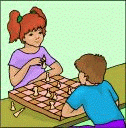 Parents
often wonder why their children are so different from
each other even though they are raised in the very same
family. In addition to genetic differences, competition
among siblings does affect the development of other children
in the family, and may be the most important reason why
children raised in the same way are so different.
Parents
often wonder why their children are so different from
each other even though they are raised in the very same
family. In addition to genetic differences, competition
among siblings does affect the development of other children
in the family, and may be the most important reason why
children raised in the same way are so different.
Sometimes, second or third children feel inadequate by comparison to a first sibling and thus search for different areas of expertise. Parents often reinforce those differences because they want to encourage self-esteem in each child and also fear that the second or third child may not be as skilled as the first child. That process often results in parents labeling their children. For example, if the first child is considered the "scholar," the second child may be referred to as the "creative" child, the "social" child, or the "athlete." Those labels may increase the competitiveness within the family because each child believes he/she should be best in the family at something. Labeling also causes children to assume they are not good at whatever another sibling is best at. So the scholars may assume they can't be creative, and the creative children may give up on academics because they believe they can't achieve as good grades as their sibling.
Children in the same family are surely different from each other but also have much in common. If the children study and do homework, it is likely they will all be reasonably good students. Indeed, families should encourage their children to know they can have a whole smart family. Children can also be physically fit, although they may surely choose different sports or activities to exercise their fitness.
Even social skills can be learned, and although some children may enjoy friends more than others, labeling your children as the social ones has the impact of directing them to be the best partiers, and you will surely regret that label by their teenage years.
Dr. Anne Caroles, Psychologist* Dr. Anne Caroles was referred to as the "brain" in her family. Her sister was called the "beauty." As a teenager, Anne viewed herself as "ugly" and believed she would never be attractive to anyone. Her studies became a hiding place for her. Now she looks back at her pictures and realizes she was quite normal looking. *Excerpt
from See Jane Win by Sylvia B. Rimm (1999, Crown Publishing.) |
When children are labeled best in a domain, they often do their best to prevent another sibling from encroaching on their domain. They feel ownership and are threatened by a sister or brother who is as good in math or better in sports. Sometimes they even beg their parent not to let their siblings participate in their activities. It would be better to talk to your child about the jealousy they feel than to prevent another sibling from joining a particular activity. Sometimes you may find your children have little confidence in their abilities; thus, you may decide to protect that child's domain. That would be particularly so if you have one child in the family who seems best at everything else.
How Sibling Competition Causes Underachievement
 There are specific sibling combinations that predispose
children toward underachievement. These particular combinations
are inherently more competitive than usual, and one or
more of the siblings are disadvantaged by this competition.
Many families learn to minimize minor sibling rivalry
or at least assist siblings in dealing with their competitiveness.
However, with these special combinations, the parenting
job is extremely challenging.
There are specific sibling combinations that predispose
children toward underachievement. These particular combinations
are inherently more competitive than usual, and one or
more of the siblings are disadvantaged by this competition.
Many families learn to minimize minor sibling rivalry
or at least assist siblings in dealing with their competitiveness.
However, with these special combinations, the parenting
job is extremely challenging.
The combinations that seem unusually difficult include: very close-aged, same-gender siblings, siblings of an extremely gifted child, and a family of children with one who is considerably younger.
TWO CLOSE-AGED, SAME-GENDER CHILDREN
Judge Edna Conway* Judge Edna Conway’s success seemed to grow in contrast to her older sister’s lack of success. No challenge was too difficult for Edna. She would quietly assess each obstacle, admit that perhaps it might be difficult, and then decide it wouldn’t be impossible. Her conclusion typically was, "I think I can do that—I just have to keep going." Edna’s sister, in stark contrast, was negative about almost everything, was pessimistic, complained about any chore, and completed very little of what she began. Edna explained, "I felt more like an oldest or only child and always felt ready to step out on my own." Edna not only graduated college and law school, but was also elected to a judgeship. Her sister dropped out of college and struggled with finding any positive direction. *Excerpt from See Jane Win, by Sylvia B. Rimm (1999, Crown Publishing) |
Where two close-aged, same-gender siblings are treated similarly, both children are likely to feel more competitive pressure. Because they are expected to act the same, the age difference typically puts stress on the younger one to keep up with the older one, causing the younger one to feel inadequate. The older one may also feel some frustration because he doesn’t receive special privileges that go with age. Because the older sibling usually outperforms the younger, he will appear confident. Both siblings are also likely to compete for a close relationship with the same-gender or most powerful parent. Recognizing individuality by acknowledging privileges of age and differences in interests and abilities relieves some of the competitive pressures. However, parents can expect to be frustrated as they try to deal with two competitive brothers or two hostile sisters who should be such good company for each other.
FOLLOWING A VERY TALENTED
OLDEST CHILD
When the first child exhibits unusual talent, she is likely to be the recipient of special parent and school attention, unusual educational opportunities, and a multitude of honors and awards. This child thus becomes the pace-setter for the siblings who follow. High standards are set, and younger siblings believe that in order to earn equal recognition they must achieve a similar level of success.
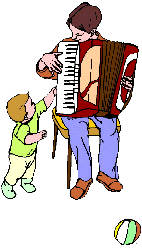 Even
if your children are very capable, they are likely to
view such accomplishment as quite impossible and may
feel great pressure. Because they want to establish
an individual and respectable place in the family, and
because they view themselves as unlikely to compete
successfully, they may select a different and sometimes
opposite direction for achievement and attention. If
the family can encourage their activities and help them
to understand their competitive feelings, the child
may develop both competence and confidence.
Even
if your children are very capable, they are likely to
view such accomplishment as quite impossible and may
feel great pressure. Because they want to establish
an individual and respectable place in the family, and
because they view themselves as unlikely to compete
successfully, they may select a different and sometimes
opposite direction for achievement and attention. If
the family can encourage their activities and help them
to understand their competitive feelings, the child
may develop both competence and confidence.
If the oldest sibling’s accomplishments are significant, it’s often difficult to convince younger children of their own talent. In such cases they may resort to underachievement for attention seeking. Their failures and behavior problems may thus become their route to family recognition. They manipulate family members to attend to their problems, thus setting an underachieving cycle in motion.
THE "BABY" OF THE FAMILY
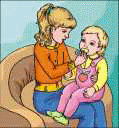 The
sibling combination in which the youngest is labeled
the "baby of the family" may also initiate
underachievement. The youngest child is by no means
always an underachiever. As a matter of fact, research
on eminence finds youngest children to be second only
to oldest children as achievers. However, if youngest
children are either over-indulged or overempowered by
older siblings, particularly when they are much younger
than the others, they may likely be underachievers.
The
sibling combination in which the youngest is labeled
the "baby of the family" may also initiate
underachievement. The youngest child is by no means
always an underachiever. As a matter of fact, research
on eminence finds youngest children to be second only
to oldest children as achievers. However, if youngest
children are either over-indulged or overempowered by
older siblings, particularly when they are much younger
than the others, they may likely be underachievers.
Older children may treat their youngest siblings almost as toy dolls and do so much for them that the younger ones are prevented from developing their own ideas and activities. In this case they become dependent on the positive feedback from older siblings and may become fearful of assuming responsibilities or initiating creative activities. The youngest child may see little likelihood of becoming as competent and successful as older siblings, and besides, it’s much easier to get help from the collection of "big" people around them.
WHAT PARENTS CAN DO TO
CREATE A WHOLE SMART FAMILY
Dr. Sandra Calvin, Engineer* Dr. Sandra Calvin’s family provides an excellent prototype of how parents can raise a whole smart family. Although there were five children in the family, all went to college and all have careers. Sandra’s parents considered all the kids to be smart, including her brother, who had a learning disability. Being smart and hardworking were both assumed and emphasized. The children varied in their musical and athletic skills and activities, but all participated in both. The whole family was included whether they were going to a concert or a basketball game. Music, science, camping, and sports were part of growing up in their enriched family environment. It was just assumed that all would continue their education beyond high school, and indeed they all did. *Excerpts from See Jane Win by Sylvia B. Rimm (1999, Crown Publishing.) |
Avoid labeling. Although it's obvious that all children in the family are not genetically alike and that some children may have differences in intellectual, artistic, musical, or physical abilities, it’s also obvious that family competition seems to encourage each child in the family to seek special attention. When parents label their children, it limits their confidence in almost all other areas.
Prioritize education as first. It’s important for parents to consider all their children intelligent even if one seems a bit more intelligent than the others. When parents expect all their children to be smart and value challenge, the children are actually less competitive with each other.
Consider both parents intelligent. When parents consider each other to be intelligent, their children have high regard for both. Regardless of which parent children identify with, they automatically consider themselves smart.
HOW TO BE A WHOLE SMART FAMILY
- Cheer for your siblings and they'll cheer for you.
- You may be second best in your family but might be best if you were in other families.
- Even if you're best in your family, you might be second best compared to another family.
- Doing the best you can do is more important than being best in the family.
- Learn to enjoy your experiences and improvement without continually comparing yourself to your siblings.
- Effort and attitude count.
©2002 by Sylvia B. Rimm. All rights reserved. This publication, or parts thereof, may not be reproduced in any form without written permission of the author.